LAVA began Fund I with two theses: trust and simple finance. That is, we want to invest in companies and/or products which lower the cost of money in Africa, and therefore make local monies more usable and useful for everyday people.
Reimagining how trust works is roughly equivalent to lowering the cost of money because we can reduce intermediation (both in terms of middlemen, and in terms of “middleman currencies” like USD) and therefore transact more frequently, at higher volumes, with lower margins.
However, there is a chicken and egg problem, because we need liquidity to leverage the benefits of less intermediated, more trustworthy markets. In the absence of real liquidity (whether that’s in specific markets like Nigerian derivatives, or in “African capital markets” writ large) the bootstrap we need is not just less intermediation. It is public market rules which let anyone participate on the same footing. It is what we call credibly neutral markets.
Assets can trade more easily if and only if they are trading in markets where the rules are clearly encoded and applied without favour. It’s the way the market operates and whether everyone can use it or not that matters, not how and when any given asset is tokenised. If you don’t believe us, consider Hyperliquid.
However, not everything financial can be housed with perps. Credibly neutral markets matter not just in the context of abstract financial bits, but all the way down to physical atoms themselves.
Some Energising Context
South Africa operates one of Africa's two largest electricity systems and arguably its most complex industrial electricity ecosystem. Its sophisticated tariffs, extensive transmission network, diverse generation assets and ongoing market liberalisation place it at the forefront of African electricity-market development. As it transitions toward competitive wholesale electricity trading, South Africa has an opportunity to establish market structures, pricing mechanisms and financial instruments that could influence how electricity is generated, traded and financed across the continent.
However, the proposed new market, the South African Wholesale Energy Market (SAWEM), is far from credibly neutral. This essay will show where it falls short and discuss why this prevents us from investing in any particular player lining up to take part.
What does SAWEM have to do with LAVA’s two theses? Energy generation and distribution is where trust and finance overlap most consequentially for modern society.
We know from our work in simple finance that there is a deep link between the sort of money Bitcoin is and energy. However, Bitcoin is only the tip of the iceberg. Credibly neutral markets for energy trading are what we’re after, and these likely require a more programmable medium than Bitcoin.
We are not alone in this thinking. Global funds like Ribbit and Crucible have written extensively about similar trends they see in America. However, they are not required to think about the cost of money (it is a solved problem if you only operate in USD). They also do not seem to have paid as much attention to the microstructure of, say, ERCOT (the wholesale electricity market in Texas) or NEM (the National Electricity Market of Australia) as we will pay to SAWEM.
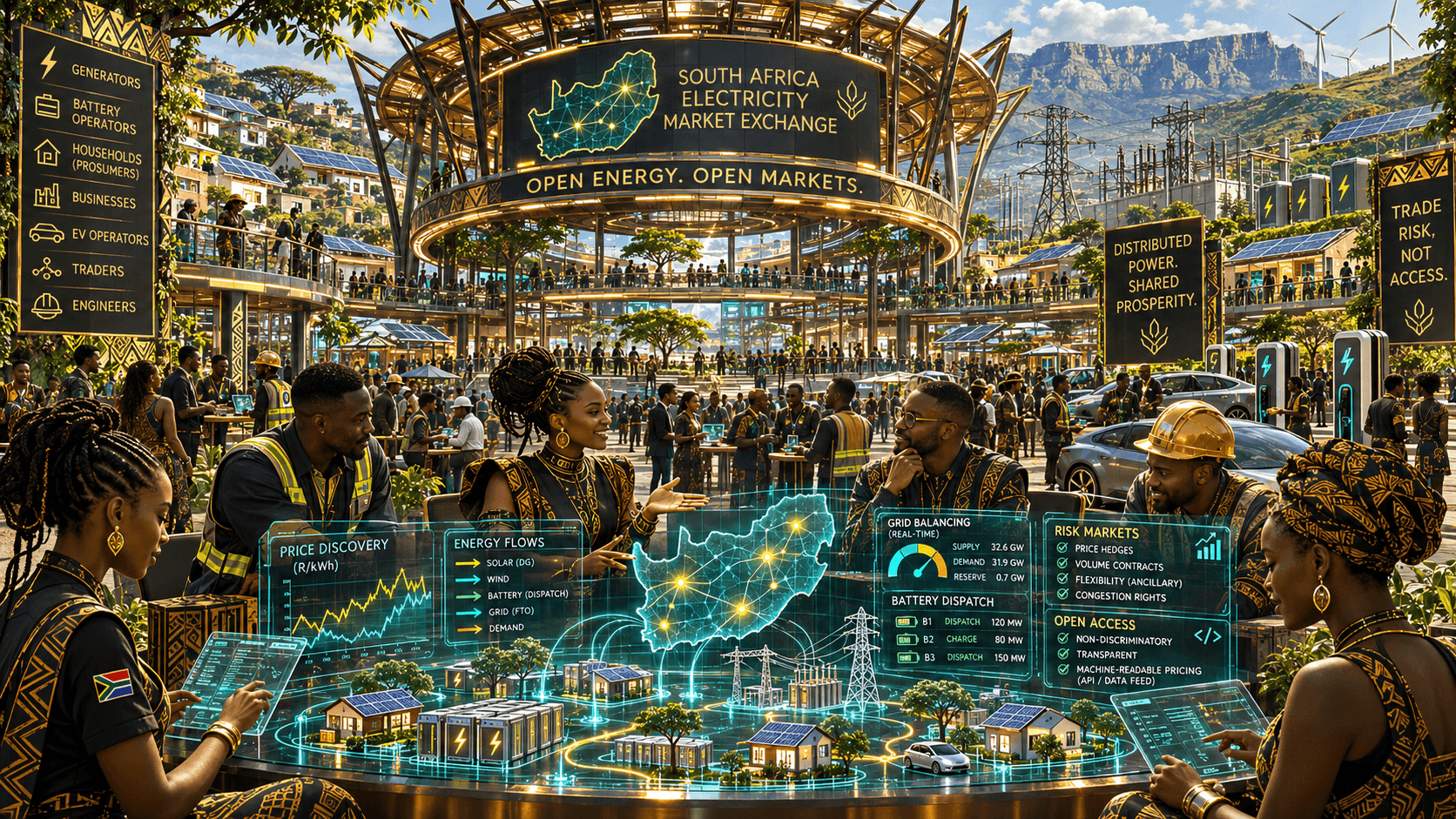
The Proposed Design
There is an interactive visual explainer of SAWEM here: https://sawem.clarity.engp.co.za/
The visual explainer of the overall system should give you a sense of how complex it is to create an energy trading market for a whole country. There is a lot of physical machinery and wiring, as well as legacy charges and contracts and historical context at play, before we even begin to consider the actual market structure. We are impressed that South Africa has even come this far, which is why we initially started looking for investment opportunities more seriously.
1. Slow Start
Eskom is South Africa’s state-owned monopoly. The proposed draft for SAWEM suggests a “slow transition” from the current single-generator-and-distributor model to the wholesale energy market. We get it: the grid is national key point infrastructure. It is good to be conservative in such domains.
But there is long history here. South Africa has been discussing electricity-market liberalisation for roughly 30 years, with formal government proposals dating back to 1998. The idea of separating Eskom's generation, transmission and distribution businesses is nearly as old. A “slow start” in the face of 30 years of stalled legislation is not conservative, it is an extension of the same kind of protectionist control Eskom is famous for.
A recent report from a consulting firm says South Africans can expect a “an Eskom-dominated market with little external price discovery until the early 2030s.” Who does this benefit, and what does it imply about the way the market is being rolled out? Our perspective is that the implicit goal is the ongoing protection of Eskom’s revenues, and that the legislation implies the market is designed for control, more than it is designed for efficiency or genuinely open participation.
2. Fixed Costs
In addition to essentially controlling prices in the market until at least 2032, Eskom gets to recover its fixed costs and its fuel costs through regulated tariffs and vesting contracts, independent of SAWEM prices.
Eskom is currently aiming for as much as 70% of its costs to be declared as “fixed”, with no independent verification of this figure required in the draft legislation. The marginal costs Eskom can bid in SAWEM would then be artificially low, and obliterate meaningful competition. We are not the only ones to notice this very obvious flaw.
The incompetent incumbent recovers costs outside the bid while competitors must finance theirs from the market price. A market can only be credibly neutral when participants face the same rules and prices reveal the cost of their choices.
3. Legacy Charges
There are legacy charges which are not all easy to understand. What is being recovered, who pays, and when does the charge end? Without a credible sunset, a transitional charge risks becoming permanent. Such charges mean that what you pay in SAWEM is not necessarily representative of the full cost of electricity through your meter, which introduces all sorts of accounting issues, inefficiencies, and weird incentives around how and what people quote.
4. Manual Onboarding
You need to complete 3 days of compulsory SAWEM school to join the market. This schooling covers:
- Market Structure and Governance,
- Roles of Participants (e.g., Balancing Responsible Parties, Scheduling Agents)
- Registration and Credit Requirements
- Market Timelines and Gate Closure
- Balancing, Settlements, and Risk Management
- Trading Platforms and Interactive Market Simulations
In other words, the bureaucrats will teach you a bunch of market-specific rules and regulations. The more control and arbitrary constraints there are, the less liquidity will actually come and the less true price discovery will ensue.
5. Manual Review
The Krutham paper makes the point that,
“The draft trading platform framework adds a constraint, as it bans participants’ automated systems from submitting bids and offers without manual review for five years from commercial launch, which is about April 2032 if launch happens in April 2027. The framework says NERSA will review the restriction but sets no date, trigger or criteria, so five years is the default.”
Again, credibly neutral markets are not artificially constrained. This is a critical point to understand, because it is not just about whether the rules that are codified treat all participants equally. Liquidity will only aggregate into meaningful markets if they do not include rules that bar entry or complicate price discovery.
A market that requires permission to reach the wires and a human to review automated orders for five years will not attract sufficient liquidity, because it is not credibly neutral. If the rules protect incumbent revenues, restrict access and delay a trustworthy price, startups cannot build scalable businesses around trading risk, and venture capital cannot enter.
The Opportunities
When bureaucrats design controlled markets, they inadvertently create some opportunities. And this is where we diverge with consultants like Krutham. They rightly point out that:
“The Market Operator is not planning a renewable energy certificate (REC) market, futures, forwards or other derivatives, so these will come from the private sector.”
Such markets obviously depend on SAWEM being able to produce a reliable spot price (which depends on the issues above being properly attended to). If that happens, then creating this market is a big opportunity. However, Krutham suggests that the JSE gets involved and that we should “build bank capability in stages”. The default mindset, even outside government, is to rely on the incumbents.
The JSE currently settles trades, at best, T+1. How does that fit with the hourly trading proposed for SAWEM? Outside of all the other FCSA and PA regulations that must be navigated, defaulting to a traditional exchange (with arcane things like investor protection levies, because they take so long to settle) just feels like the wrong way to approach this.
And why should we rely on the banks to build capacity? Are they the best-placed players to make these kinds of markets? Only if you assume that the market must be a walled garden with big barriers to entry and a permissioned set of participants.
Krutham goes even further:
“When the Sawem launches, a Battery Energy Storage System (BESS) operator will hold an options position on the daily price spread, making it the first counterparty for any bank building intraday price risk products. A revenue swap is required here, where a BESS operator receives a fixed rand amount per megawatt per year from the bank. The bank then receives the floating index value based on actual intraday battery revenue.”
Why would a BESS operator want to hand over variable revenues for fixed income from a bank!? Such operators are surely in pole position, if the market is truly open.
I don’t want a bank to smooth out my revenue curve, for a fee, especially in the age of AI. I want a genuinely liquid market, where I can trade front of meter (without any guaranteed off-take agreement, or PPA, or other complex legal machinery that reduces fungibility), such that I can optimise my profits and sale my own ship on a sea of free energy. It is obvious that banks specialise in intermediation, which comes at a hefty cost, both to individual users of their services, and in terms of overall market efficiency.
Global Precedent
One last point, not specific to market structure, is that a focus on control and on how old incumbents can get a slice of the new pie that is SAWEM prevents us learning from the best we see in other markets. We see nothing akin to public programs like the Cheaper Home Battery Program in Australia, or the room being created for private companies like Base in Texas.
South Africa has extensive experience with tax incentives for residential solar panel installation, and energy efficiency in general. These programs were largely successful (there is now between 3-5GW excess energy in the grid at midday). It would be great to see residential generation and storage included in SAWEM’s overall design and future plans.
Distributed energy storage makes good sense across Africa, given the difficulties and costs associated with long distance transmission, as well as the capital intensive nature of large scale generation projects. Moreover, retail users can and do play an important role in balancing the grid, especially at the dreaded evening peak. Those same retail users can and should be able to participate in energy trading markets.
Summing Up
There is an opportunity for South Africa to establish a market structure, pricing mechanisms and financial instruments that could influence how electricity is generated, traded and financed across the continent. However, the idea that we need to continue to protect Eskom’s revenues; that they can declare and recover their fixed costs outside of SAWEM’s prices; and all the manual onboarding and review processes currently contemplated combine to make the current proposed market highly controlled, rather than credibly neutral.
Moreover, if we rely on the banks and existing exchange infrastructure, the most a startup can do is gather proprietary data about the biggest consumers on the grid. They can then use this to verify whatever prices are being set on SAWEM (if that even matters, depending on Eskom’s fixed costs and the actual depth of liquidity circa 2032), such that banks can make markets with CfDs and other futures.
Perhaps some decent business will emerge from that sort of structure, but none of them seem like viable venture bets to us. The market structure simply does not permit them to grow sufficiently.
The strongest opportunity is in owning and trading risk, not merely verifying prices for incumbents.
We also see no clarity on how bespoke PPAs, and whatever complex CfDs can be created off the back of them and an Eskom-dominated (manipulated?) spot market, can ever be streamlined into fungible, easily-tradable futures of any kind. This is a tractable problem, but we see no genuinely clear thinking around it so far.
It makes the question, “What are we actually trading in SAWEM?” quite difficult to answer for any prospective investor. We know that physical atoms can trade hourly; bilateral contracts and financial CfDs are separate; standardised futures remain prospective. The problem is that a credible reference price, standard terms and liquid secondary market are not assured and seem difficult to get to given the current draft design.
A credibly neutral energy market needs cost-reflective bids, transparent and time-limited legacy charges, non-discriminatory access, public machine-readable prices, and standardised contracts. Small generators and batteries should be able to participate directly. Whatever safety, credit and reliability rules are genuinely required must protect the grid, not incumbent revenues.
Future Forward
What would we find genuinely exciting, as a venture capital firm looking at this market? What we propose below will cause most current industry experts (whether energy or crypto) to scoff, but we still think it worth introducing, if only to illustrate how much economic opportunity SAWEM could create if it becomes truly open and credibly neutral.
Our basic premise is that electricity is the most natural asset to tokenise in the world. In fact, it already is tokenised in many places across the world. In South Africa, if you have a prepaid meter, you buy electricity tokens from any major retailer, enter the code into your meter, and voila! you have more electricity. It’s just not sitting on a public, transparent, programmable ledger.
Of course, if you try and tokenise the whole market, the question of what unit to tokenise comes up. In South Africa, there are 6 different charges for retail users (peak, off-peak, and standard, with different rates for summer and winter), let alone industrial and other kinds of users. Tokenising kWh in this kind of tariff environment and then hosting a liquid, fungible market is a tall order. However, we don’t need to do that.
Toggle at your own risk.
Consider that BESS operators only need fixed income revenue swaps with banks in order to access the initial capital to get set up. If they can source capital elsewhere, and sell electricity into a liquid market at reliable prices, then we can tokenise the BESS. The demand exists (and will only increase, whether due to urbanisation, or data centres, or whatever comes next), so we don’t need guaranteed off-take agreements or non-fungible PPAs. We just need a market where willing buyers can meet willing sellers at real prices.
And (hear me out!) this is the perfect place to deploy a DAO. Raise the initial capital required from global crypto looking for “real world” yield, automate the trading scheme for the BESS, and return the yield it generates from buying low and selling high to DAO members (which can be done onchain at least daily, if not hourly).
Again, what this requires is an open market, with reliable spot prices, where we can trade energy front of meter. SAWEM is a far cry from that as it stands. But we hope that we can shift the Overton Window closer to that reality with this essay. We also hope that we can help you see that, despite the current rhetoric, there are fascinating ways to think about tokenisation and DAOs that you might not have considered before.
There is a way to a more open, credibly neutral world in which power is distributed more fairly. SAWEM is not a good example of that way as it stands, but it may still become one in the fullness of time. Regardless of what happens, we hope that other African countries will learn from South Africa (both the good and the bad) and move us closer to that world as the continent becomes increasingly powerful over the coming decades.