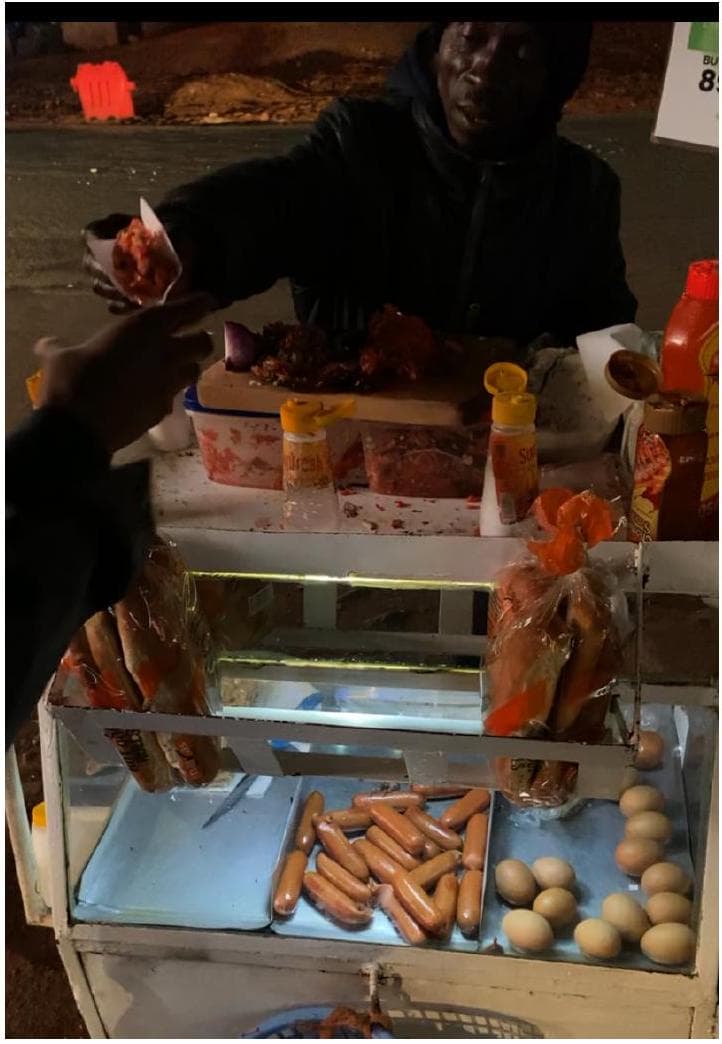
The chapati street-vendor stood outside The Alchemist, and my money was in the wrong currency.
Worse than the wrong currency, to be honest, since it was a different kind. I had a balance that had begun life as a dollar-pegged token on a public blockchain. Basically, an asset no till in Kenya will touch.
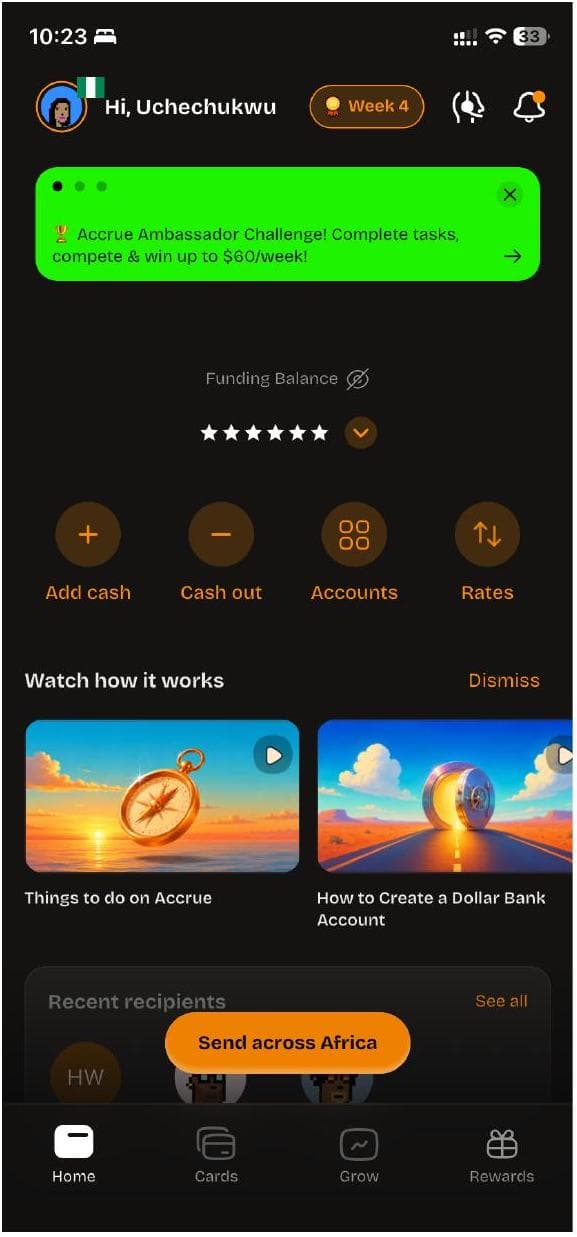
The last inch of African money has always had a face. I opened Accrue to find one, still bumping my head to Kamili, which I could hear from the speakers inside, and scrolled to Send Money Across Africa. I had just set up my M-Pesa account and linked it with Accrue after getting a Safaricom SIM that evening with nothing but my passport and ‘Asante’ in a Nigerian accent.
I navigated to Kenya, typed an amount I felt would finance the night, and pressed send. Somewhere, an agent would take my dollars and put shillings on my M-Pesa. Then I stood in the small eternity between pressing a button and money becoming real, doing what everyone does in that gap: watching AI-slop on TikTok.
What I was actually waiting for
I was waiting for a person. Every payment system ends in someone deciding this counts as money here. I was waiting for that someone.
Somewhere in Kenya, a stranger’s phone had lit up with an order at 11 pm. I imagine them the way you imagine anyone on the other end of a network: mid-task and half-distracted. To me, it was being saved from an embarrassing moment, and to them it was Friday night with hopes they might earn enough to finance whatever weekend plans they have- maybe I’m projecting a bit too much.
In the investment space, we spent a decade arguing about pipes. Correspondent banking was too slow and too expensive. It still is because sending $200 to Sub-Saharan Africa costs an average of 8.78%, the highest rate in the world, against settlement times measured in days.
Stablecoins looked like the cleanest pipe of all: 24/7, atomic, holding their value while local currencies do not. In 2024, $59B in crypto transacted in Nigeria alone - roughly 31% of nominal GDP - with stablecoins accounting for 43% of all on-chain volume in Sub-Saharan Africa. If the internet made the world a ‘global village,’ stablecoins might be its currency (with local coins having their own flavor). I assure you there are no more clichés in this piece.
A stablecoin sitting in a wallet is simply a claim on money that remains abstract until there is local alignment. And in a Nairobi shop, or a Lagos market, or somewhere in Ntonso where the nearest bank branch is an hour away from Adinkra makers, that claim is worthless until someone nearby is willing to hand over fiat for it. The scarce function across African markets is repeatedly finding someone in the right jurisdiction, with the right local currency, willing to complete the conversion.
The Human Rail
Kenya has already shown the world that financial infrastructure begins when human reliability becomes predictable enough for strangers to plan around it.
M-Pesa won because Safaricom recruited an army of humans in green-branded kiosks, on every corner, and made them the interface. The agent was the cash desk and the trust anchor at once. A person you could look in the eye, or grab by the collar.
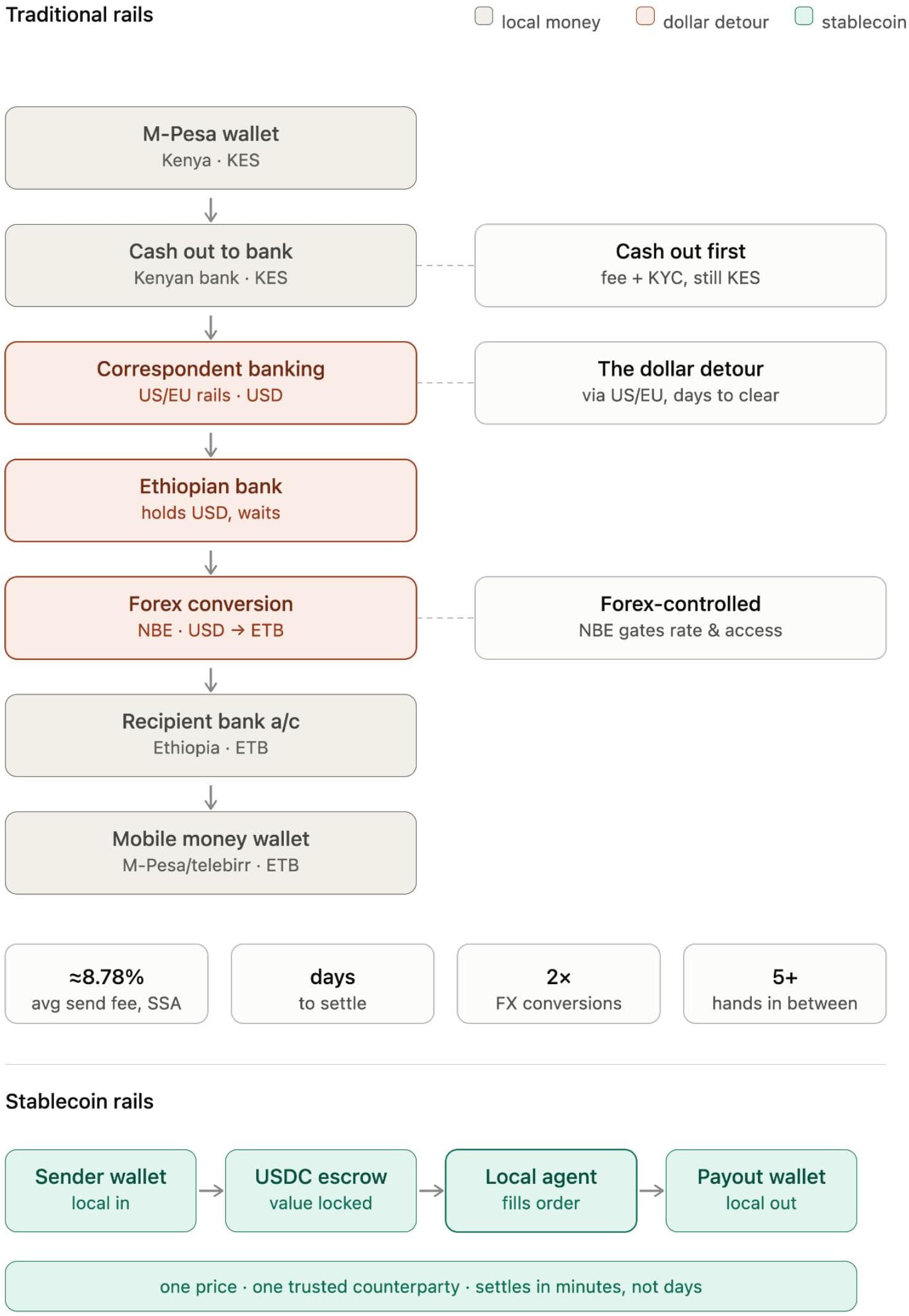
But, mobile money is geo-locked, fenced in by the fiat beneath it: your M-Pesa is taken for granted in Kenya, with that same account becoming irrelevant in Ethiopia.
Registering an agent is easy. The expensive part is producing one who lasts long enough to rebalance under stress, and be trusted with a customer’s money. Hugo Pacheco describes the accumulated result as “embedded distribution capital”: the trust, density, liquidity routines and local knowledge paid down one transaction at a time. Accrue’s insight was that this capital already exists, dispersed across African markets, and could be made to function as one network.
There are, broadly, two ways to scale the people already holding this liquidity. One is to make providers composable: wrap them in a protocol, expose them through an API, and let applications route across a shared pool.
Aggregation dominates in thin corridors, where no single network can justify the cost of recruiting and retaining local liquidity, and the rational move is to share a pool. Exclusivity dominates in dense ones, where enough repeat flow exists to make a reputation worth protecting and an agent’s best hour worth competing for. Whilst Paycrest, a portfolio company, is betting the map stays thin, Accrue is betting it thickens, corridor by corridor, and that whoever holds the settlement record when it does will not have to share it.
Underneath the consumer app sits Cashramp: more than 21,000 registered agents, 3,300+ verified, most of them former mobile-money operators or informal FX traders. Of the agents who have completed a trade, roughly nine in ten come back, with D30 retention sitting at 56.8% and D90 at 45.5%.
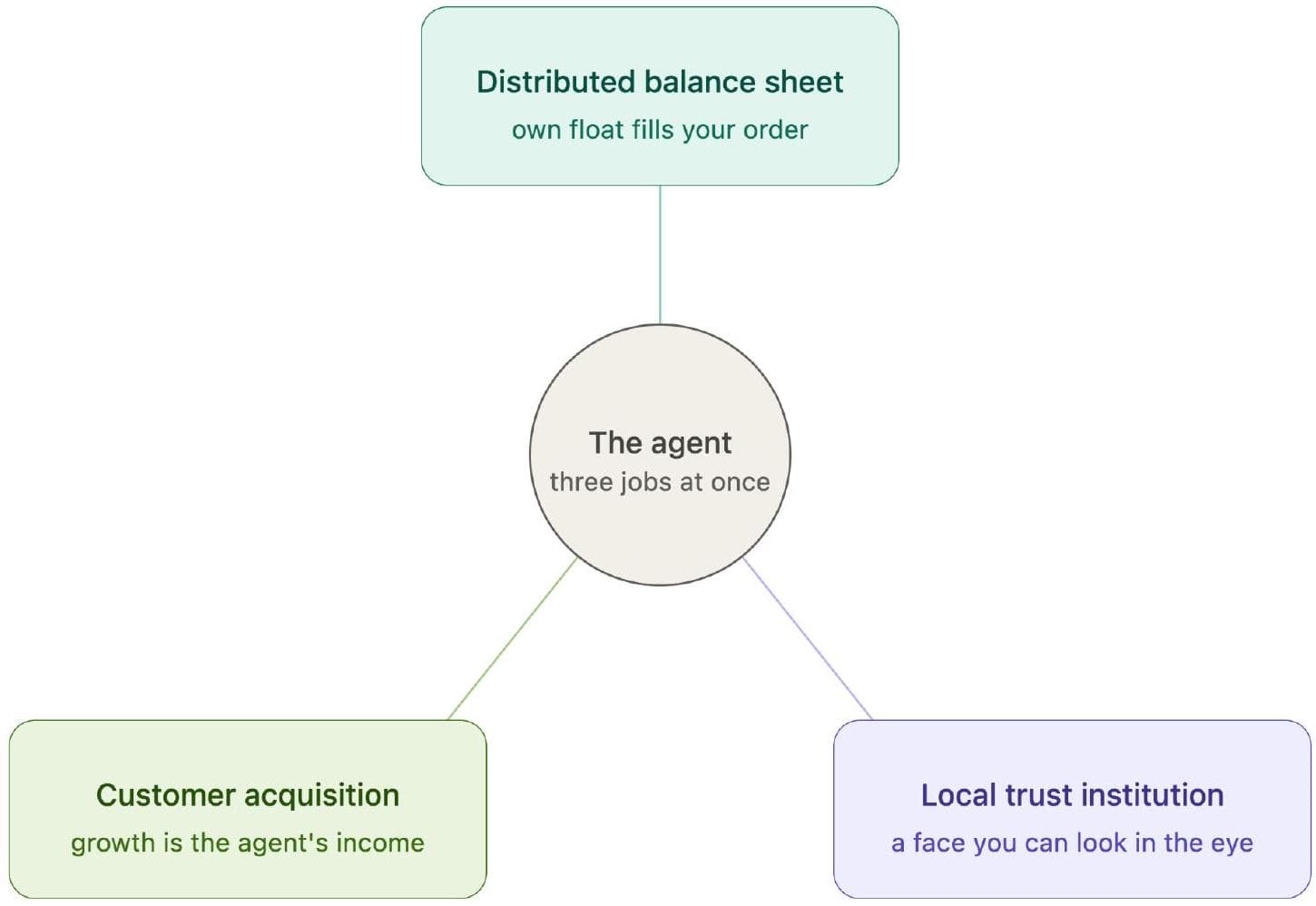
Each agent is doing three jobs at once:
- a distributed balance sheet - the agent’s own float, in local currency, is the liquidity that actually fills your order;
- a customer-acquisition channel - agents market the product and onboard their neighbors because the network’s growth is their income;
- a local trust institution - the person a customer can look in the eye or call via phone.
Accrue does not warehouse the fiat. The agents carry the local FX risk, put up the working capital, and earn the spread. Accrue escrows the stablecoin side of every trade and routes each order to whoever can fill it fastest. Underneath sits a reputation graph from a million-plus completed trades, plus the verification that keeps agents honest.
In fragmented African markets, where human agents can’t be temporary scaffolding, successful startups like MoniePoint made the human layer searchable and routable. The outstanding, and most important action was to also make them accountable.
Accrue therefore has to become the venue where agents receive the most consistent demand, and build the most valuable reputation.
The confirmation
My phone buzzed. M-Pesa: shillings received. It was the most ordinary message in Kenya, the one every mama mboga and boda rider knows by sight.
I paid the vendor. He did not know, and would not have cared, that the money had been a dollar-denominated token on a public blockchain a few minutes earlier.
The Big Squeeze
Clinton Mbah, Accrue’s CEO, has a name for the moment his industry entered in 2025: the Big Squeeze. Regulatory clarity arrived, and the core African corridors got licensing frameworks for crypto. The future the team had bet on showed up. From above: incumbents with massive distribution, from PayPal to Flutterwave, announcing stablecoin plays. From below: hundreds of startups chasing the same flow. Accrue sits in the middle of the sandwich.
The squeeze exists because stablecoins are a platform, and platforms commoditize what sits beneath them. The way M-Pesa turned cash handling from an operational capability into a line item anyone could rent, stablecoins turn permissioned access to closed financial networks into open, programmable money.
We have argued this from the investor’s side of the table: when every input is rentable, durable value settles wherever a scarce function is being defended which most of the time will not be an interface.
Clinton’s own read has softened. “I used to be a bit more afraid of the squeeze, but I’ve become less so,” he says. “If you have relentless execution, you’re not complacent, you figure out a sustainable model, those give us the best chance.” He doesn’t dismiss the incumbents. “They still have very strong distribution moats you can’t underestimate,” but he’s willing to name the endgame most operators won’t say aloud: “Hopefully someone notices the good work and says, okay, let’s bring this under our wings and continue to build it out.”
The platform makes the middle easy, but the edges, getting money in and out, managing liquidity, FX risk, compliance, are where most products die. Accrue’s bet is to own those edges by becoming the network that coordinates the thousands of small principals who already do.
The team that followed the behavior

Accrue was not designed to be this. It launched in 2021 as a crypto investment app built around dollar-cost averaging. Over time, users kept gravitating to the stablecoin feature, to move and hold value that didn’t melt with sky-rocketing inflation in Nigeria.
In late 2022, low on cash and bruised by a run of investor rejections, Clinton heard from a friend who had just spent an entire day inside a string of Ghanaian banks trying to send money to her aunt in Nigeria. Nothing worked. He pointed her at a half-finished “pay” button in the app. She deposited with a Ghanaian agent, received stablecoins, and had them paid out as naira by an agent in Nigeria. “It completed in like five minutes,” he recalls. “There has to be something there.”
Set against a savings model that, even at an industry leader’s scale, had produced perhaps $250M in AUM after years, it was nowhere near enough to carry a venture-backed business. The signal was flashed. “This is literally the only part of our business that is growing,” Clinton says. “So this is like our final Hail Mary before we run out of money.” They killed the DCA product.
That same instinct treating behavior as the product roadmap is what brought Cashramp into existence.
The team
The team is spearheaded by Clinton Mbah, who leads alongside his co-founders Adesuwa Omoruyi and Zino Asamaige.
Clinton moved to Ghana when he was a child, and grew up straddling two currencies. “There’s no world in which I am going to queue at a bank for hours on end to send 50,000 naira,” he says. Helicarrier, the crypto shop behind Buycoins and Sendcash, taught him what a clean solution should feel like. His standard is stated as a negative: “I wouldn’t be someone that would put out a shit app.”
Adesuwa’s account is more disarming. She did not start out in love with the problem. “I honestly wasn’t passionate about the intra-African payment problem,” she says. “What I really was at the time was just very delusional about how we could build this company that could end up being something meaningful.” The delusion did its job. It carried her through the years when nothing worked, and hardened into conviction: “I constantly think about how it’s easier to send money from the US to Nigeria than it is from Nigeria to Ghana. I just find it so embarrassing that that is the case.”
What holds the three together shows up in the unglamorous evidence. They went unpaid for the first year and, more than once, put the team’s salaries above their own. And the trust is total in the place it matters: “If Clinton and Zino are having a meeting I couldn’t join, I can be sure they’ll do what’s best for the company” Adesuwa says.
What the network has-and has not-proved
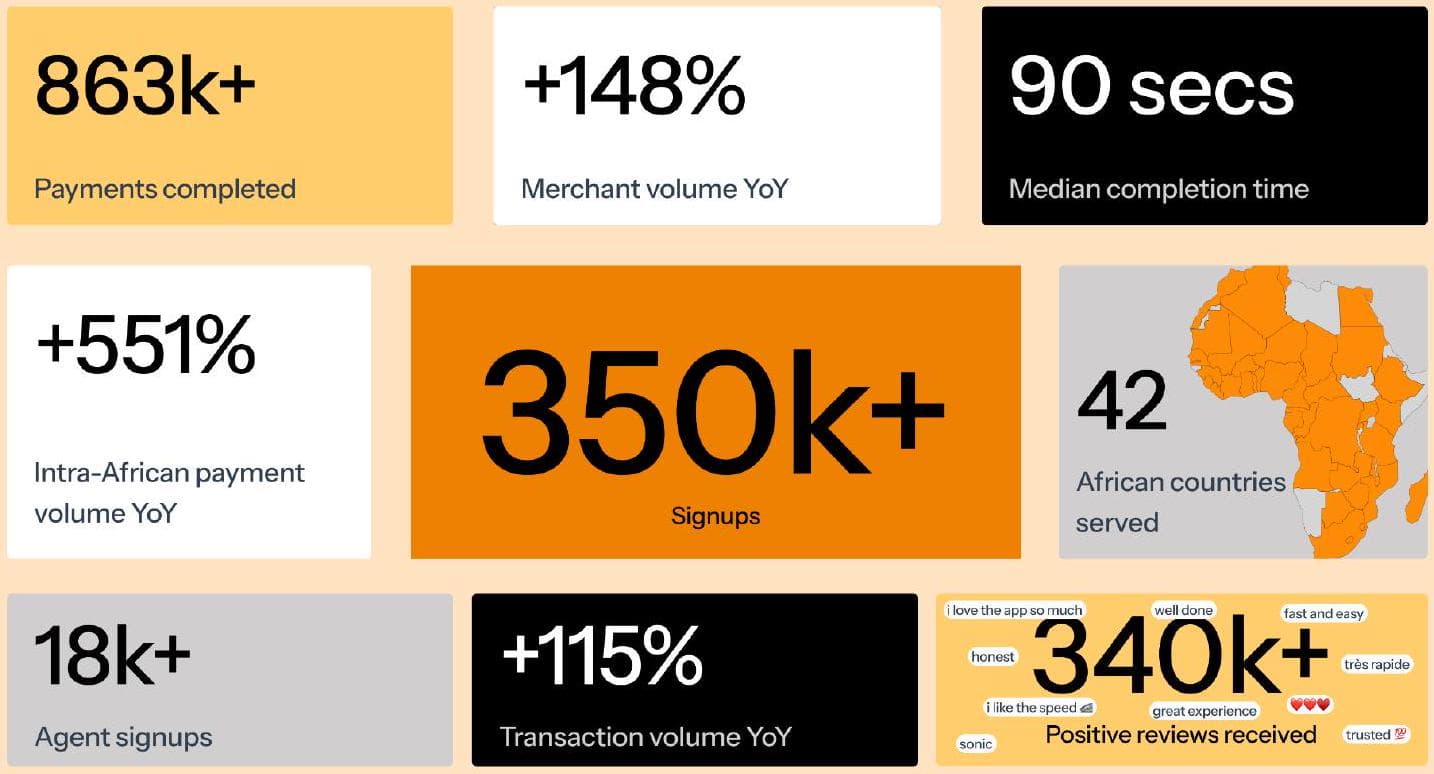
Accrue Stats, Feb. 2026. Figures in the text are current to July 2026 and will not match the panel above.
The team manufactured demand with unusual creativity. They worked a student-ambassador network to reach Nigerian students in Ghana who needed money from home, ran dollar savings as a loss leader to acquire Ghanaians during devaluation and then upsold them on transfers, and built a weekly Twitter quiz on African currencies whose shareable results looped new users back in. Adesuwa recounts, “every Friday when we do the quiz, we’d record at least 30 to 40% more signups that day.”
Across 21,000 agent sign-ups and sixteen countries, the median payment completes in about ninety seconds, against more than 430,000 positive reviews from the customer’s side of the trade.
Besides being a loved consumer app, the team has launched a business product and strengthened a network spanning sixteen countries on a single $$ 1.58$ million seed round led by Lattice Fund. Its capital efficiency comes from making thousands of external balance sheets usable as one network rather than warehousing every currency itself.
This efficiency is growing, and being replicated. The network expanded into Côte d’Ivoire, Togo, Benin, DR Congo, and Zimbabwe to reach sixteen countries, and it is now the default on/off-ramp for Opera’s MiniPay wallet in several markets. Transaction volume is up 115% year over year, cross-border volume $551 %$, and merchant volume $148 %$. In July 2026, the same rails were extended to companies as Accrue Business with wallets, virtual USD/EUR accounts, invoicing, cards, and on-chain payroll, all settling through the same agents. And Kenya, where this essay began, grew organically, with no marketing spend. The network just worked, and I told people. I am, in a sense, still telling them.
A Cashramp agent is economically incentivized, with the reported potential to earn up to $150 a week, to recruit users and compete for more flow. Accrue earns when the network completes a transaction, at 91.7% gross margins on Cashramp today. The venture case turns on whether greater corridor density lowers fulfillment, support, and failure costs faster than competition compresses Accrue’s revenue per transaction. If density improves both reliability and contribution margin, the network compounds economically as well as operationally.
To ensure reliability, the fraternal twin of Trust, every trade is escrowed. The stablecoin leg is secured inside Cashramp before the corresponding fiat payout completes. As such, a settled trade does not rest on bilateral trust between strangers, and agents are verified and carry reputation from every completed order.
The figures show genuine reach and quality under load. But, they do not, on their own, yet prove durable network power.
Where the network fractures, or compounds
The failure mode is easiest to see in a cold corridor. When Accrue entered Cameroon, it launched with a single serious agent that was a Binance trader for whom Accrue was a side gig. “He was the only agent, so he could set any rates he wanted. If he’s offline, he wouldn’t turn off his profile,” Clinton says. “I’d have to be calling him: check your Cashramp, there’s an order to fulfill.” The rule of thumb was clear, and a sharp heuristic was established: “If they’re a hungry agent, you’ve lucked out. If they’re someone a bit more successful, you’re cooked.”
Density is what dissolves that dependency because once several agents compete in a corridor, the incentive inverts. “The way you rise to the top of the order queue is by providing the best exchange rates,” and pricing, speed, and reliability improve without Accrue lifting a finger. The network even recruits itself: an agent near the Cameroonian border once crossed over to sign up friends so he could serve the Nigeria-Cameroon corridor, and a Kenyan agent traveled to Tanzania and Uganda to do the same. “I am incentivized to help the network grow,” Clinton says, “because if the network grows, I get more orders.”
That resilience also depends on demand. Across the stablecoin market, B2B flows have generally proved more predictable than consumer activity. Accrue Business is therefore a product expansion, and the test of whether the network can attract predictable, repeat demand.
Cashramp’s system itself is not capital-light. Every order requires an agent to warehouse local currency and bear the opportunity cost of keeping it available. If returns on that float deteriorate, the network can become shallow in practice. Regulation compounds the challenge because the same clarity that legitimises stablecoins also raises the cost of operating across sixteen African corridors through local entities, licences, compliance personnel and, in NIGERIA some markets, regulatory capital.
On reliability, escrow addresses only part of this exposure. It secures the stablecoin leg of an individual trade, while the local bank or mobile-money account remains vulnerable. A desk can be shuttered or a regulator can turn cold without warning. Accrue can distribute and manage these risks, but it cannot remove the institutional friction surrounding local fiat.
Then, there is dollar gravity. For an individual, escaping a depreciating currency is rational self-preservation. Repeated across millions of people, the same decision can weaken the monetary system they share. Accrue’s longer-term challenge is to make stablecoins useful as settlement infrastructure without making dollars the final destination of every transaction.
Clinton is candid that local stablecoins are not the near-term answer: “At the moment, it feels too early because local stablecoins don’t yet have that kind of demand.” The one path he can see runs through scale. “Once I have maybe 20 million customers across Africa, a customer walks into your shop, scans a QR code, we send you stablecoins - the fee is maybe 0.2% versus the 2 to 3% mobile money would charge. This is a digital version of the Ghana cedi.” The liquidity map underlines why: South Africa’s interbank fees “broke the economics of our agent network,” Malawi and Zambia are too thin and too dollar-preferring for a two-sided book, and Francophone West Africa where “huge swaths of countries share the same currency” is the region where local-currency demand actually holds. Thus, a local-stablecoin future is a function of user density, and the nature of the flow.
Over the next year, the thesis will become easier to test. It strengthens if active-agent retention rises with new corridors developing recurring liquidity without permanent subsidy. Also, if revenue and gross profit keep pace with volume, and Accrue Business creates predictable settlement demand. It weakens if agents send their best liquidity elsewhere, or activity remains concentrated in a few corridors with little retained revenue.
If the thesis holds, the transaction history creates further optionality. Every completed order improves Accrue’s understanding of agent reliability, immediately strengthening routing and demand allocation. That record has begun to underwrite capital. Accrue’s largest credit lines go to agents “that have been with us two to three years without any fraud complaints, very good reviews, high completion times. Some have done billions of naira in completed transactions.” The lines carry no interest; they simply enlarge an agent’s float so they can fill bigger orders, and Accrue earns on the transactions that follow. “It’s basically a win-win symbiotic relationship.”
The last inch has a face
Somewhere in Nairobi, the person who filled my order has long since moved on to the next one. They will never know that their ninety seconds of ordinary work became an essay, or that firms across the world see in them and thousands like them, the balance sheets that make African stablecoins useful.
Between me, on my way to the next club, and that chapati stood one person with shillings and a reputation to protect. Accrue’s wager is that software can remember what the market already knows about them: whether they answer, whether they settle and whether they are there again tomorrow. The last inch of African money has always had a face. Now, Accrue must give it institutional memory.
The investable question is whether that memory earns the network something agent count cannot: the best agents’ deepest float and their loyalty when a competitor offers one more basis point. “A competitor who doesn’t have this relationship, who doesn’t have this data of who’s trustworthy can’t replicate this,” Clinton opines.
Ask him how this ends well and the answer is disciplined: “Accrue wins if we stay ahead of the pack. We cannot afford to be complacent; we cannot afford not to have a sustainable business… You make something people really like, and you’re never complacent about delivering that excellence.”
If it does, every completed order makes Africa’s informal liquidity a little more legible, and a little harder for anyone else to assemble from scratch. To deliver this Last Inch, that is why we backed Accrue.